Who pays? Ask the straws.
The check lands and the math starts: who had the extra beer, who only had a salad. Skip it. Everyone pulls a straw, the short straw pays, and next time the odds are even again.
Because every draw is recorded with a verifiable random seed, the one who pays can check the math themselves. No rigged draws, no rematch demands.
The same draw settles every shared cost that does not divide cleanly: the tab, the tank of gas, the group gift, who gets stuck booking the trip. One pull decides it, and the receipt means nobody relitigates it on the drive home.
Draw for the bill →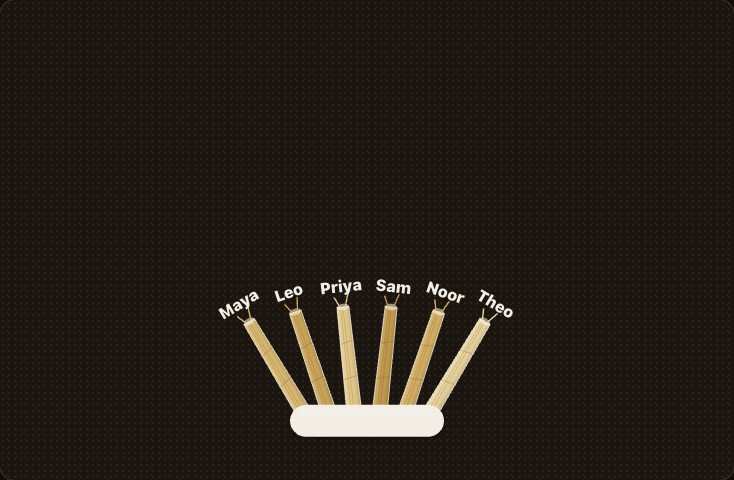
How it works
-
1
Add everyone at the table
First names are enough.
-
2
Everyone pulls a straw
Pass the phone. Dramatic pauses encouraged.
-
3
Short straw pays
Share the result link with the table as the receipt.
Why 'short straw pays' beats splitting evenly
An even split sounds fair until you remember who ordered the steak and who had tap water. Itemizing fixes that but kills the mood and takes ten minutes. Drawing for the whole bill trades exact fairness on one night for rough fairness over many: across a year of dinners, random selection spreads the cost about evenly, and no single meal turns into accounting.
It also sidesteps the awkward part, where the person who had the least feels cheap asking to pay less. The straws decide, so nobody has to.
Keeping it even over time
Random does not mean someone cannot lose three times running; it means the draw has no memory. Over a long enough run it balances out, but if your group wants a nudge, the simplest house rule is that last week's loser sits out this week's draw.
Save your regular crew as a group so the draw is two taps when the check arrives. Each draw still pulls fresh randomness, so the history never tilts the next result.
More than the dinner bill
The same short-straw logic handles the designated driver, who covers the toll, which roommate buys the household supplies this month, or who springs for the birthday gift everyone signs. Anything where the amount is shared but the payer is one person is a job for the straws.
When to skip the draw
A couple of times the straws should stay in the cup. If it is someone's birthday, they do not pull, that is the whole point of a birthday. If one person genuinely cannot afford to lose a round, quietly cap their exposure or leave them out; a fairness toy should never become a way to corner a friend. And if the bill is large enough that losing it would actually sting, split it and save the draw for the tip.
The draw is for the small, repeated, who-cares-but-someone-has-to decisions. Keep it there and it stays fun.
Questions
Can the phone's owner rig it?
No. The outcome is fixed by cryptographic randomness before anyone pulls, and the result page replays the recorded seed to prove the winner matches it.
What if someone doesn't believe it?
Open the result link and tap Verify. Their own browser recomputes the draw from the recorded bytes.
Can we do best of three?
You can always draw again, but the first result comes with a receipt. Choose your house rules before you pull.
Can I make the odds uneven?
No, and that is on purpose. Every name has exactly the same chance, every draw. Weighted odds would mean trusting whoever set the weights, which is the opposite of what a provably fair draw is for.
Is this gambling?
No money ever touches Draw Straws. It only picks a name; who pays a real bill, and how, is entirely between the people at the table.
It is just the two of us, still works?
Yes. Two names become a coin flip, which is the fairest way there is to decide who covers a check for two.